

Prerequisites
Before continuing, ensure you have the following:- A valid TechWolf contract and access to a live TechWolf tenant.
- This tenant must contain Employees corresponding to the Per Person
entities present in SAP SuccessFactors. This can be achieved by either:
- Using the Standard Employee Data Input Integration .
- Creating custom input integrations. When doing this, ensure the
TechWolf SkillEngine API Employees are linked with their SAP Per
Person counterparts by using the Per Person UUID (
perPersonUuid) as the TechWolf Employee ID (external_id). Additionally, each TechWolf Employee should have a custom property calledperson_id_externalwith as value thePerson External IDof the corresponding PerPerson entity in SAP SuccessFactors. More information on custom properties can be found in the API Reference .
- This tenant must contain Employees corresponding to the Per Person
entities present in SAP SuccessFactors. This can be achieved by either:
- A working SAP SuccessFactors environment with Talent Intelligence Hub enabled.
- An SAP SuccessFactors administrator user with permission to Manage OAuth 2 Client Applications and to import employee data.
- An SAP SuccessFactors user with the Integration Center permissions listed in Step 11, required to set up the Employee Growth Portfolio export schedule in the Integration Center. Preferably, this is a dedicated technical user.
- A working SAP BTP tenant with SAP Integration Suite provisioned,
including the Build Integration Scenarios capability. Your user must have
the
PI_AdministratorandPI_Integration_Developerroles. For more information on setting up Integration Suite, refer to the SAP community guide . - An AIR key, provided by your TechWolf representative.
- The Integration Suite Content Package zip file, provided by your TechWolf representative.
- Access to the TechWolf SFTP server to host the Employee Growth Portfolio export files, with a password or an SSH key. See How To: Add an SSH Key to the Integration Center .
- A successful SAP support case to whitelist the TechWolf SFTP server .
The AIR key (Application Interface Register key) is an identifier SAP issues
to certified PartnerEdge partners. The iFlows pass it in the header of every
SuccessFactors API call so SAP can attribute traffic to the TechWolf Skill
Sync partner solution. It is an identifier, not a secret credential.
If you already configured the
SAP BTP Job Skill Sync
in the same BTP tenant, the shared BTP/SuccessFactors setup (Steps 1-3 and
Steps 5-9) is already in place. You can skip to Step 4 to add the
Employee-specific permissions, Step 10 to configure the Employee iFlow, and
Step 11 to set up the Employee Growth Portfolio export schedule.
SAP BTP and SuccessFactors Configuration
TechWolf has already pre-configured some parts of the integration. The following ZIP archive contains the necessary files that will be used in the subsequent steps to configure the integration in SAP BTP and SAP SuccessFactors.Required files
Required files for the SAP BTP Employee Skill Sync Integration
1. Create a Certificate for authenticating to SuccessFactors
- In SAP Integration Suite, go to Monitor > Integrations and APIs > Manage Security > Keystore, then click Create > Key Pair.
- Set Alias to a value you will remember for Step 5 (e.g.
techwolf_skillsync_successfactors). - Set Common Name to
TechWolf_TIH_GP(hardcoded, see the warning above). - Set Country to the two-letter ISO 3166-1 alpha-2 code for your country
(e.g.
BEfor Belgium,USfor the United States). List of ISO 3166-1 alpha-2 codes . - (Optional) Change Valid Until to a date of your choice.
- Leave all other fields on their default values.
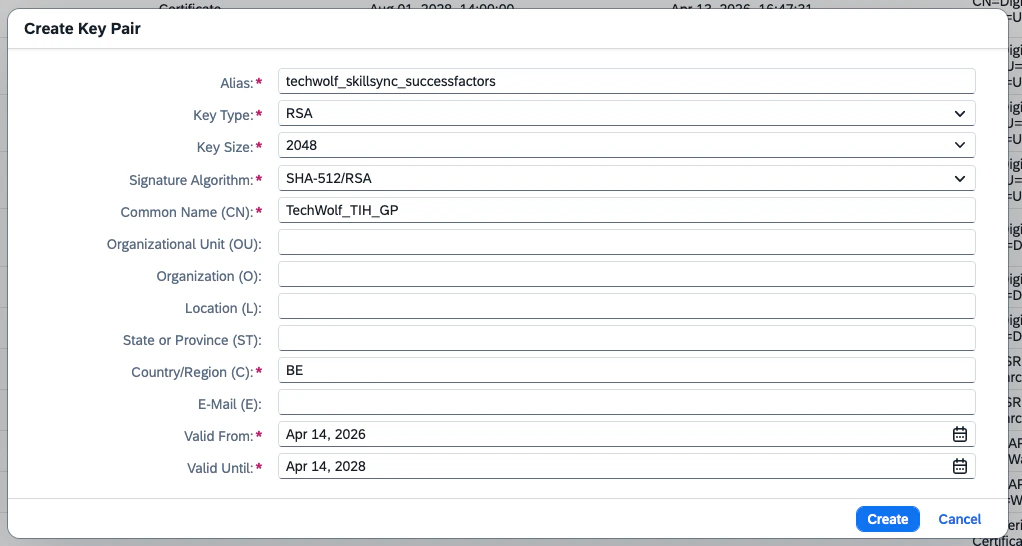
- Click Create. The new key pair appears in the Keystore overview.
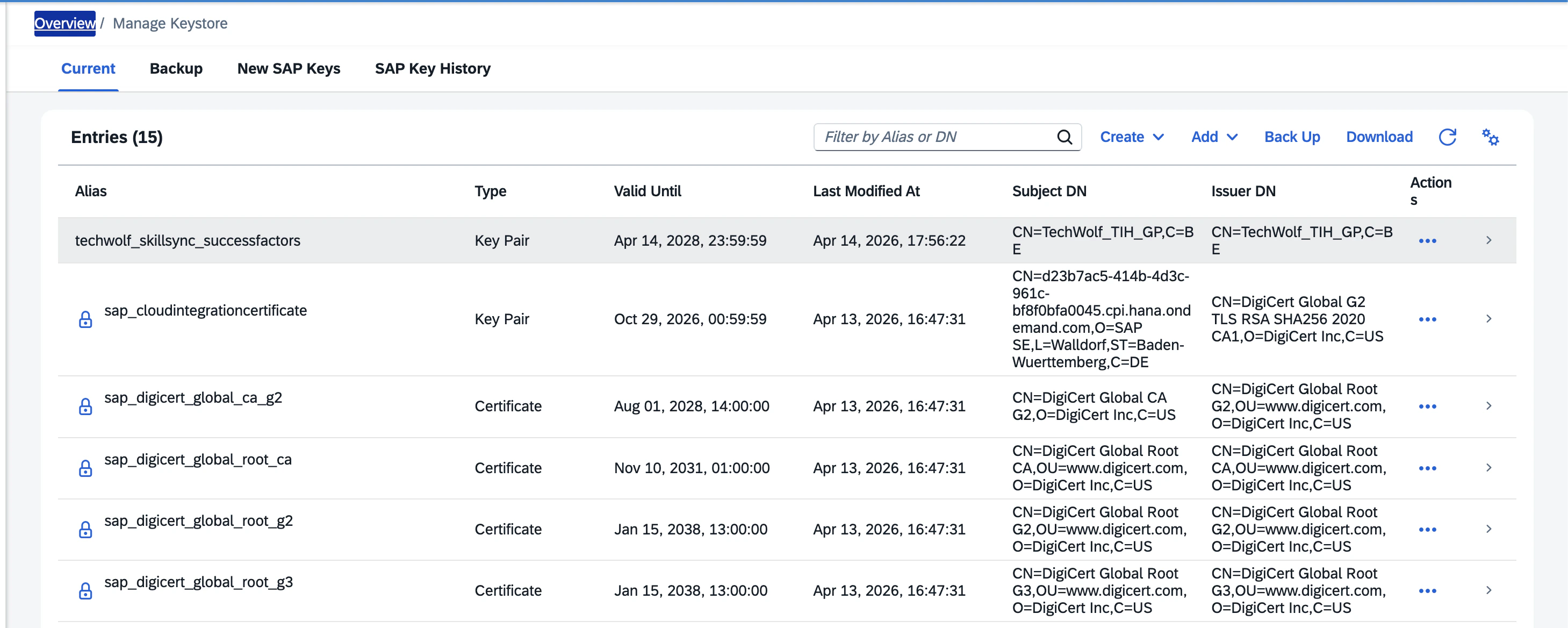
- Click the new key pair, then click Download > Certificate. Keep the downloaded certificate file available; you will paste its contents into SuccessFactors in Step 3.
2. Create the TechWolf integration user in SuccessFactors
- In the search bar at the top right of SAP SuccessFactors, enter
Import Employee Data. - In the resulting window, under the
Select an entitydropdown, choose “Basic Import”. In theChoose Filefield, upload thetechwolf_api_user_definition.csvfile from the required-files zip downloaded above.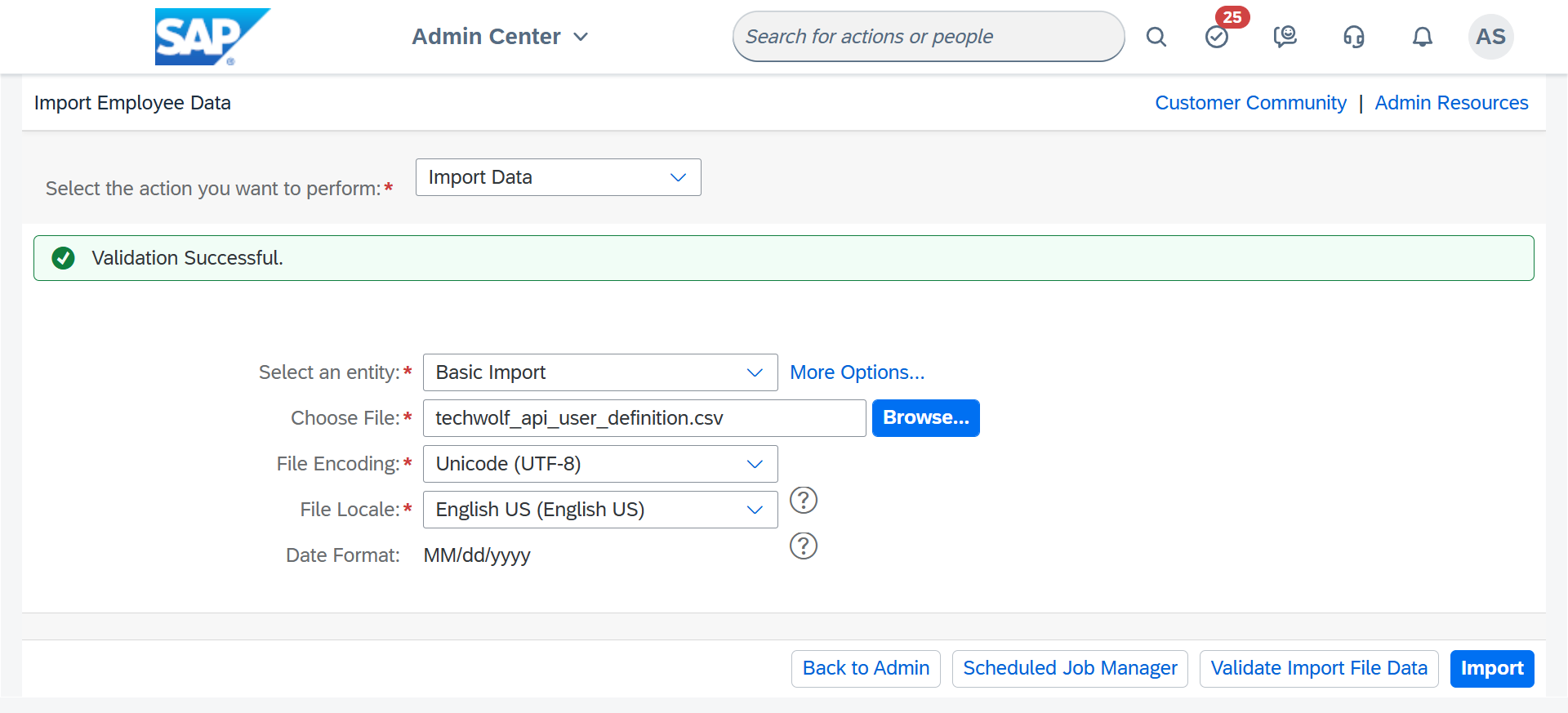
- Leave the other fields unchanged and click
Validate Import File Data. If the validation is successful, clickImport.
If you already created a TechWolf User for another TechWolf - SAP
SuccessFactors integration, this step can be skipped.
3. Configure the permissions for the TechWolf user
TheTechWolf_TIH_GP user needs a Permission Group and a Permission Role to run
the Skill Sync.
If another TechWolf - SAP SuccessFactors integration using the
TechWolf_TIH_GP user has already been configured in this tenant, the
Permission Group and Permission Role already exist. Skip the group creation
and role assignment steps below and only add the missing permissions
from the table to the existing Permission Role.-
Create a Permission Group
- In the search bar at the top, enter
Manage Permission Groupsand open it. - Click
Create New. - Name the group
TechWolf_TIH_GP. - Pick the
Usernamefilter and set it equal toTechWolf_TIH_GP. - Click
Done.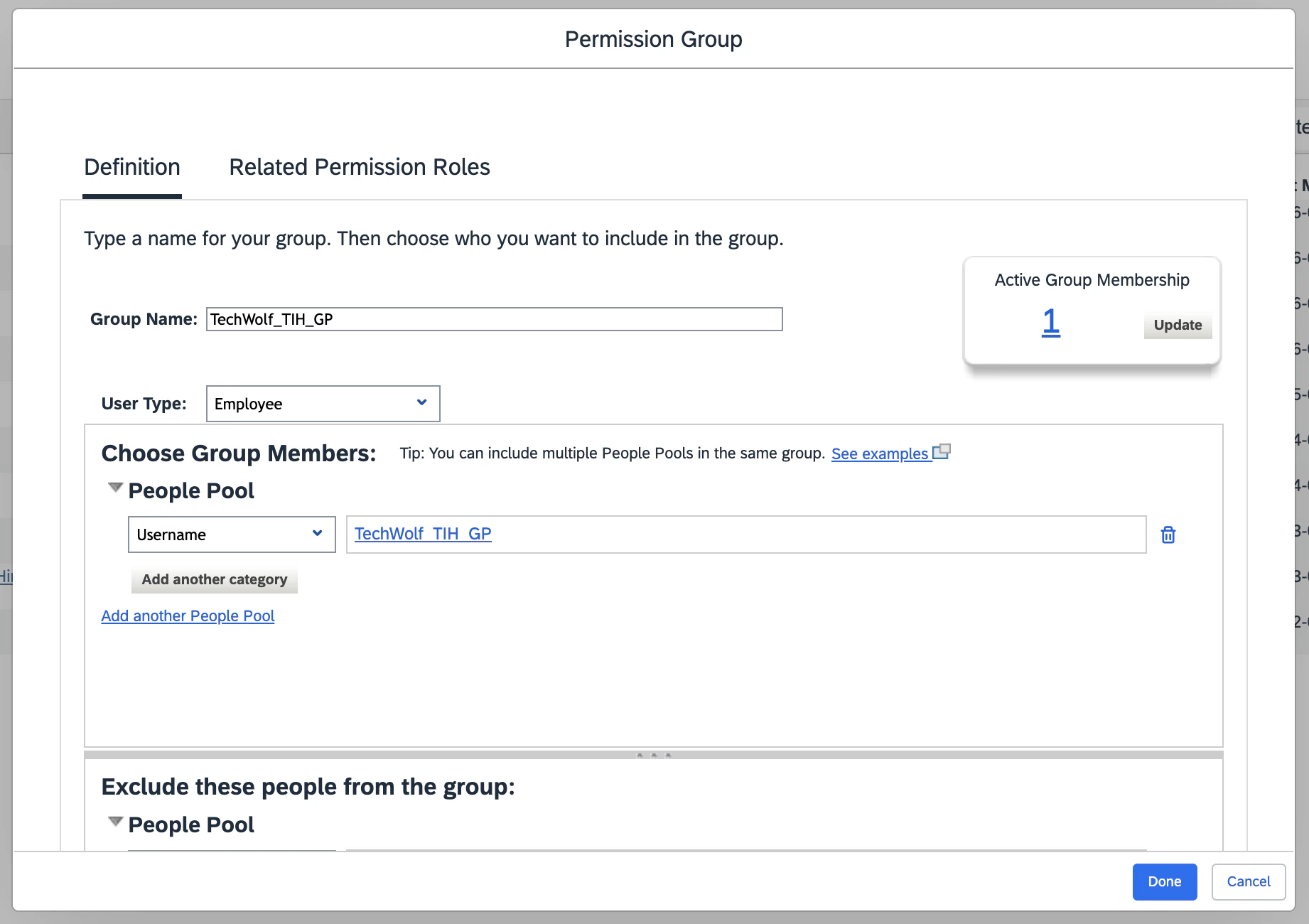
- In the search bar at the top, enter
-
Create a Permission Role
-
In the search bar at the top, enter
Manage Permission Rolesand open it. -
Create a new Role with user type
Employee. -
Under
User Permissions→Growth Portfolio, grant the following: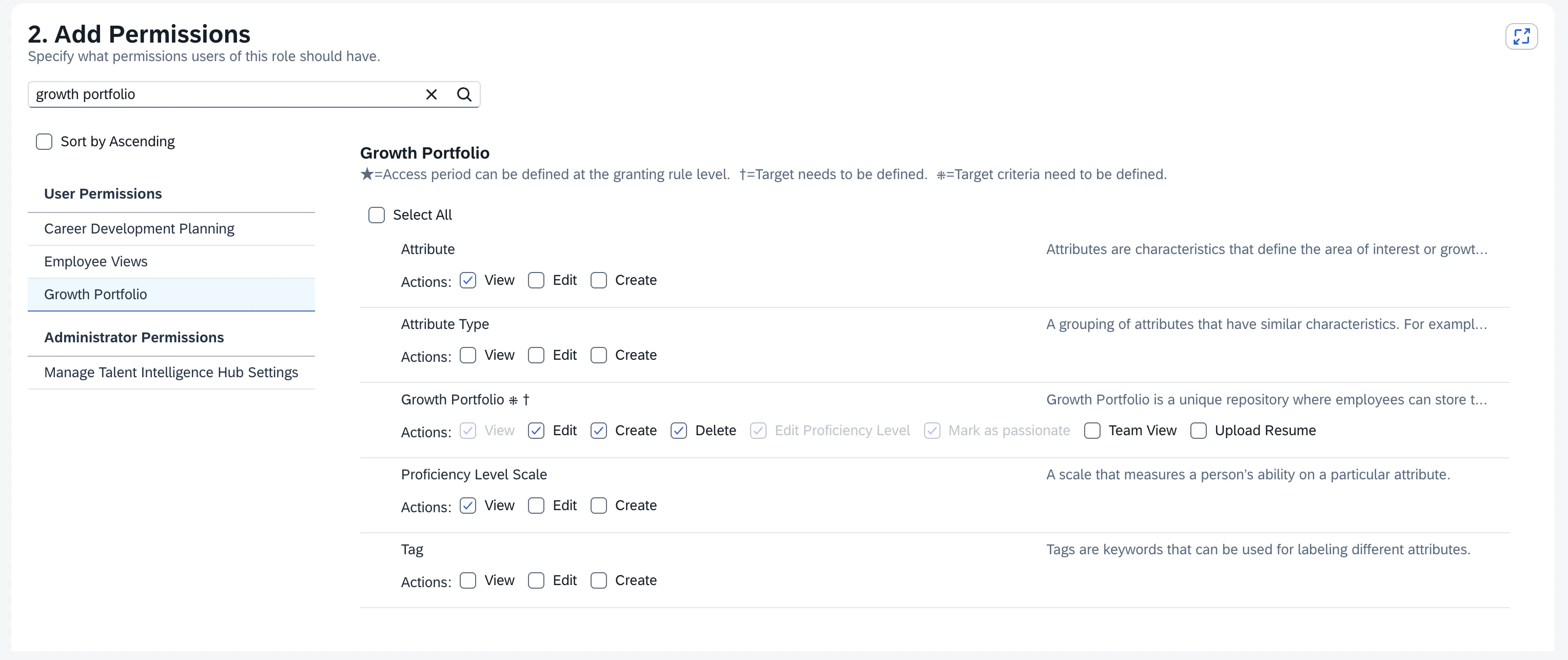
-
Under
Administrator Permissions→Manage Talent Intelligence Hub Settings, grant the following: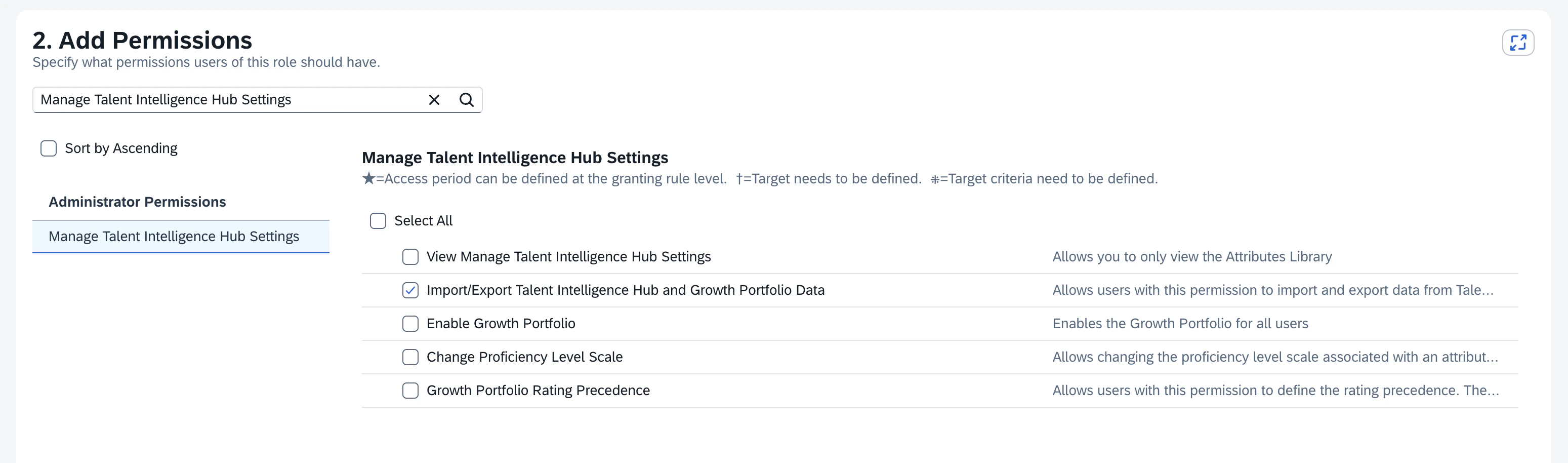
- Save the Permission Role.
-
In the search bar at the top, enter
-
Assign the Permission Role to the Permission Group
- On the saved Permission Role, click
Add Role Assignments. - Click
Next. - On the
Grant Access Topage, selectFrom Groups. - Click
Select Groupsand pick theTechWolf_TIH_GPgroup created above. - Click
Next, thenNextagain, and save the Role Assignment.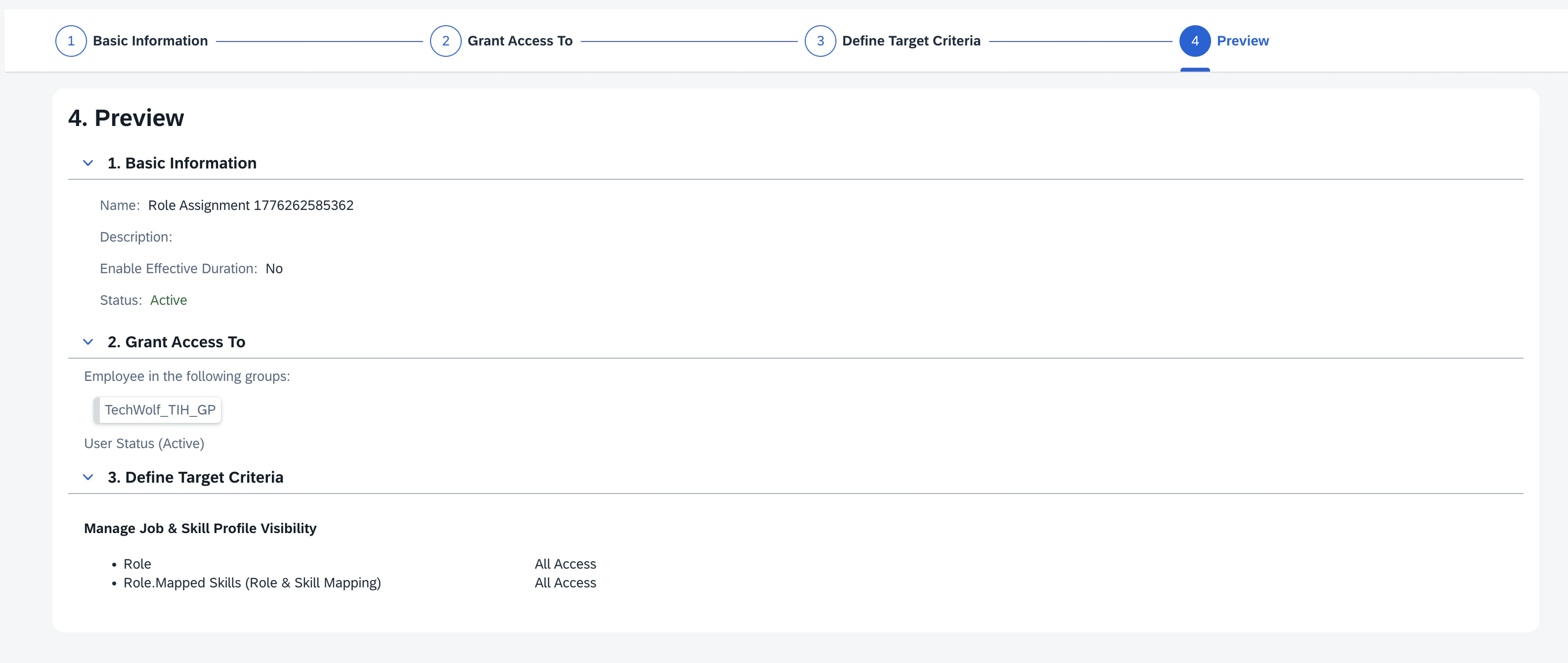
- On the saved Permission Role, click
On recent SAP SuccessFactors releases, the Talent Intelligence Hub adds data
source governance for external skill providers. If your tenant exposes the
Manage Data Sources task or a Manage Skills Governance section under
Manage Talent Intelligence Hub, complete
How To: Register TechWolf as a Trusted Data Source
so Growth Portfolio updates from TechWolf flow through without additional
manual review.
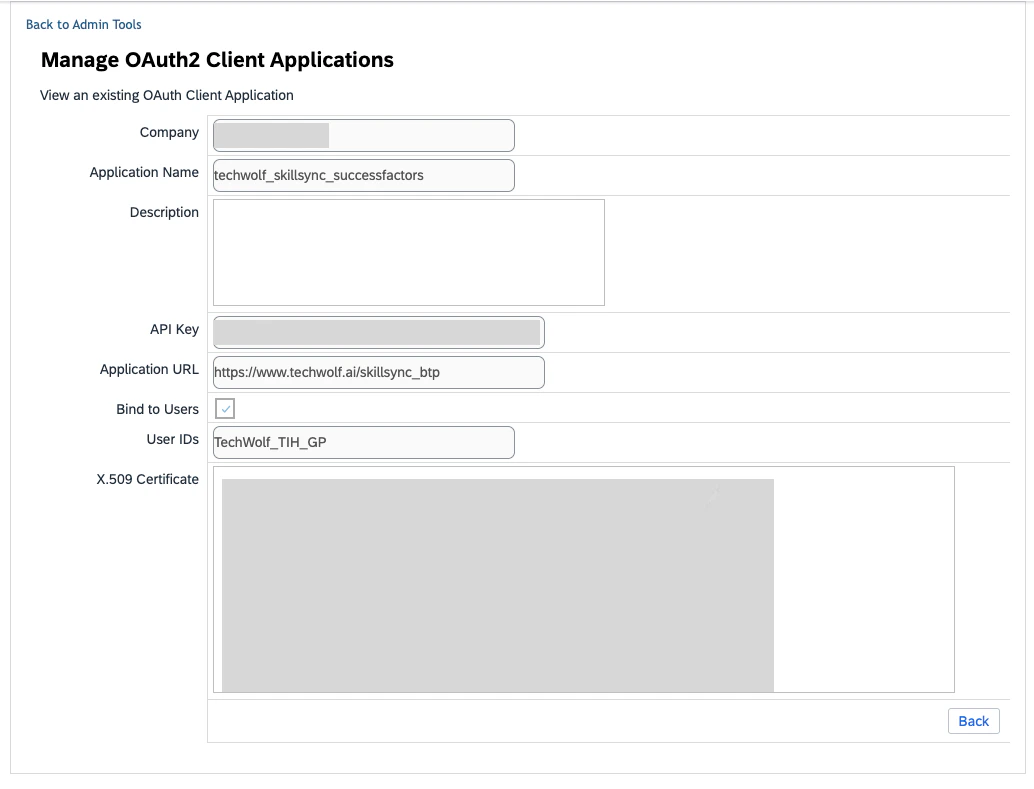
4. Set up an OAuth 2 Client Application in SuccessFactors
- In SuccessFactors, in the search bar at the top right, enter
Manage OAuth 2 Client Applicationsand press enter. - Click Register Client Application.
- Fill in the following fields:
- Application Name: any value (e.g.
techwolf_skillsync_successfactors). - Application URL: any valid URL (e.g.
https://www.techwolf.ai). - Bind to Users: check the checkbox.
- User IDs:
TechWolf_TIH_GP. - X.509 Certificate: paste the contents of the certificate downloaded in
Step 1. Remove the
-----BEGIN CERTIFICATE-----and-----END CERTIFICATE-----guards if present, and strip any line breaks so the value is a single continuous string.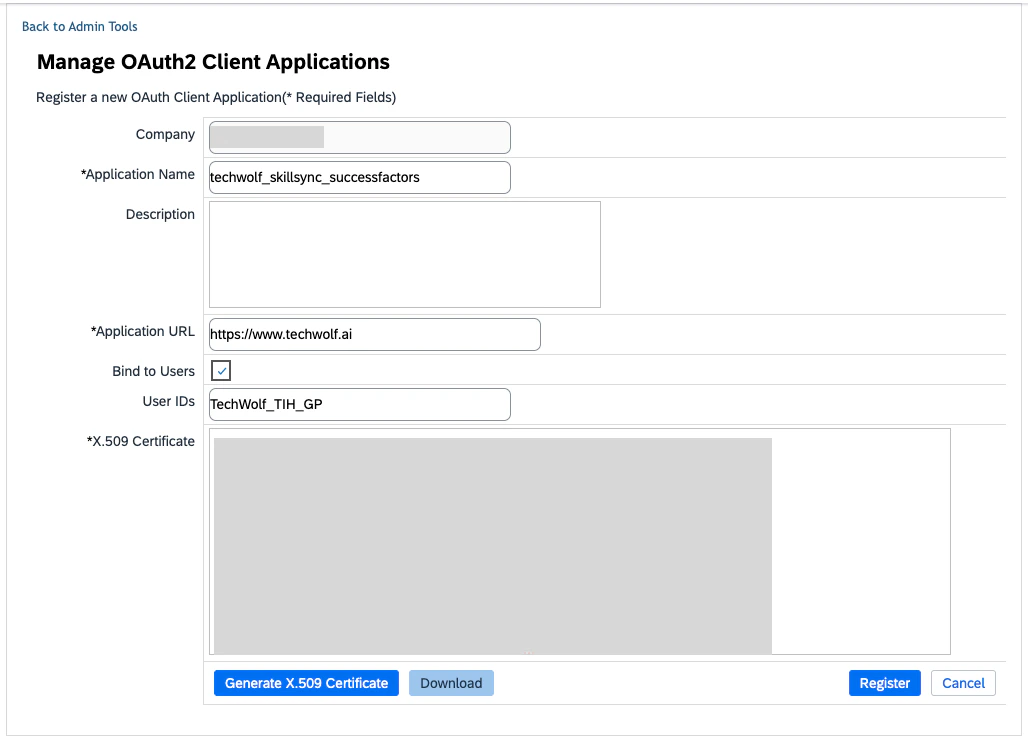
- Application Name: any value (e.g.
- Click Register. The Client Application appears in the overview.

- Click View on the new Client Application and copy the API Key. You
will need it in Step 5.
5. Configure the API credentials in SAP Integration Suite
- In SAP Integration Suite, go to Monitor > Integrations and APIs > Manage Security > Security Material and click Create > OAuth 2 SAML Bearer Assertion.
- Set Name to a value you will remember for Step 10 (e.g.
techwolf_skillsync_successfactors). - Set Audience to
www.successfactors.com. - Set Client Key to the API Key copied in Step 3.
- Set Token Service URL to the base URL of your SuccessFactors tenant,
appended with
oauth/token. See How To: Find the SAP SuccessFactors Company ID and API URL for how to look up the base URL. - Set User ID to Key pair Common Name (CN).
- Set Key Pair Alias to the alias of the key pair created in Step 1 (e.g.
techwolf_skillsync_successfactors).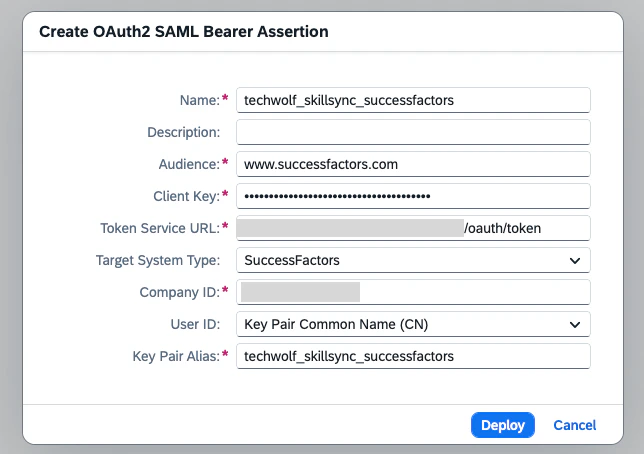
- Click Deploy.
6. Create a User Role for the integration
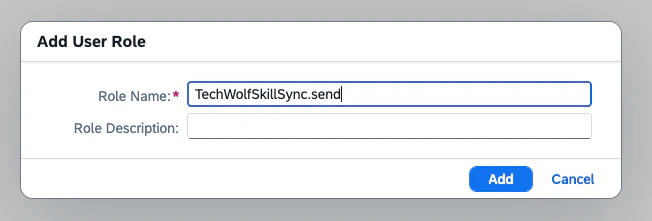
In SAP Integration Suite, go to Monitor > Integrations and APIs > Manage Security > User Roles, then click Add. Enter a Name that you will remember for Step 7 and Step 10 (e.g.TechWolfSkillSync.send) and click
Add.
7. Create a Process Integration Runtime instance
In SAP BTP, create a new instance of the Process Integration Runtime service with theintegration-flow plan.
- Check “I understand that enabling a service might result in costs, depending on the plan selected.”
- Runtime Environment: Cloud Foundry.
- Space: the Cloud Foundry space you’re deploying in.
- Instance Name: a CLI-friendly name (e.g.
techwolf-skillsync-integration-runtime).
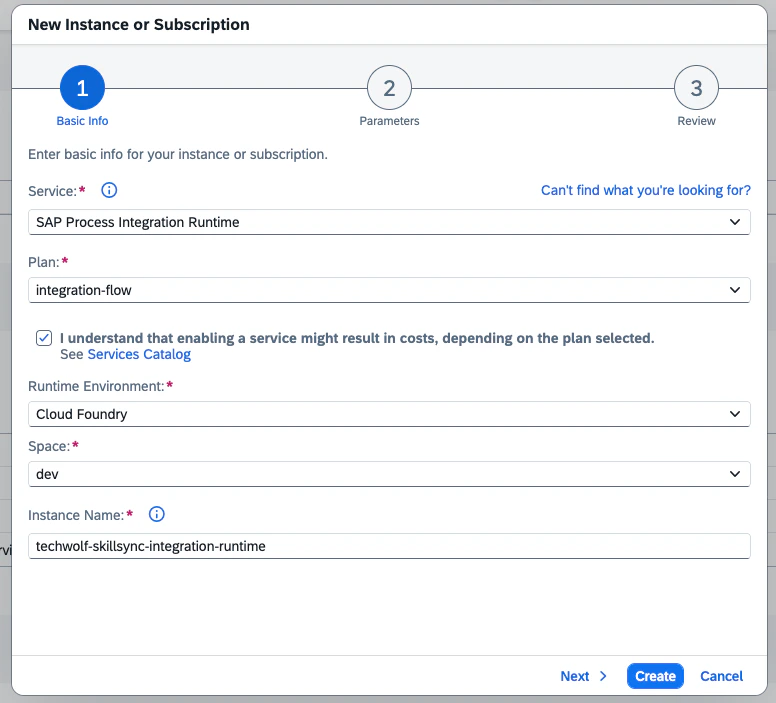
- Click Next to continue to the Parameters step.
- In Parameters, set the role to the one created in Step 6 (e.g.
TechWolfSkillSync.send). - Grant-types:
Client Credentials. - Leave all other fields on their default values.
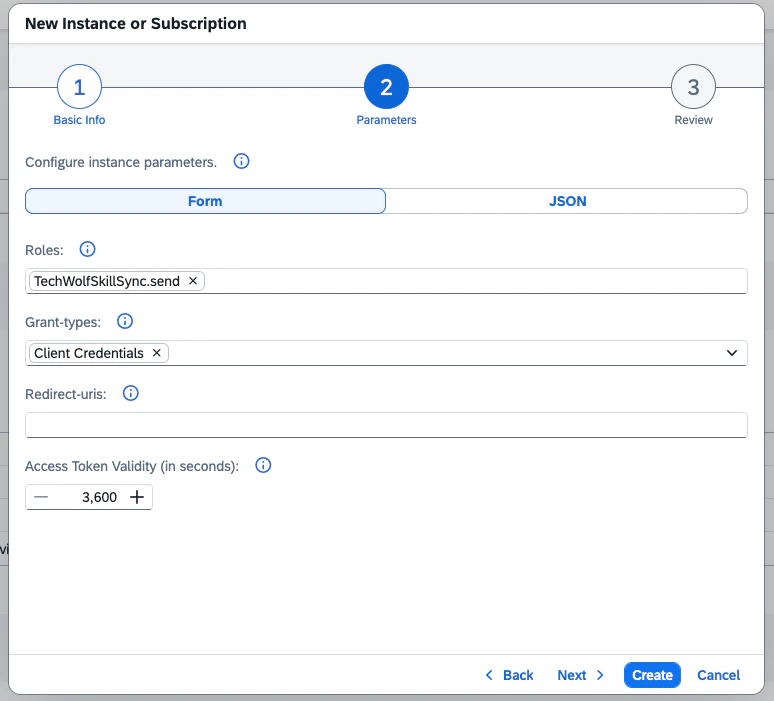
8. Create a Service Key on the instance
Find the newly created Process Integration Runtime instance. Click the three dots on the right, then click Create Service Key.- Service Key Name: any value (e.g.
TechWolfSkillSync). - Key Type:
ClientId/Secret. - Leave all other fields on their default values.
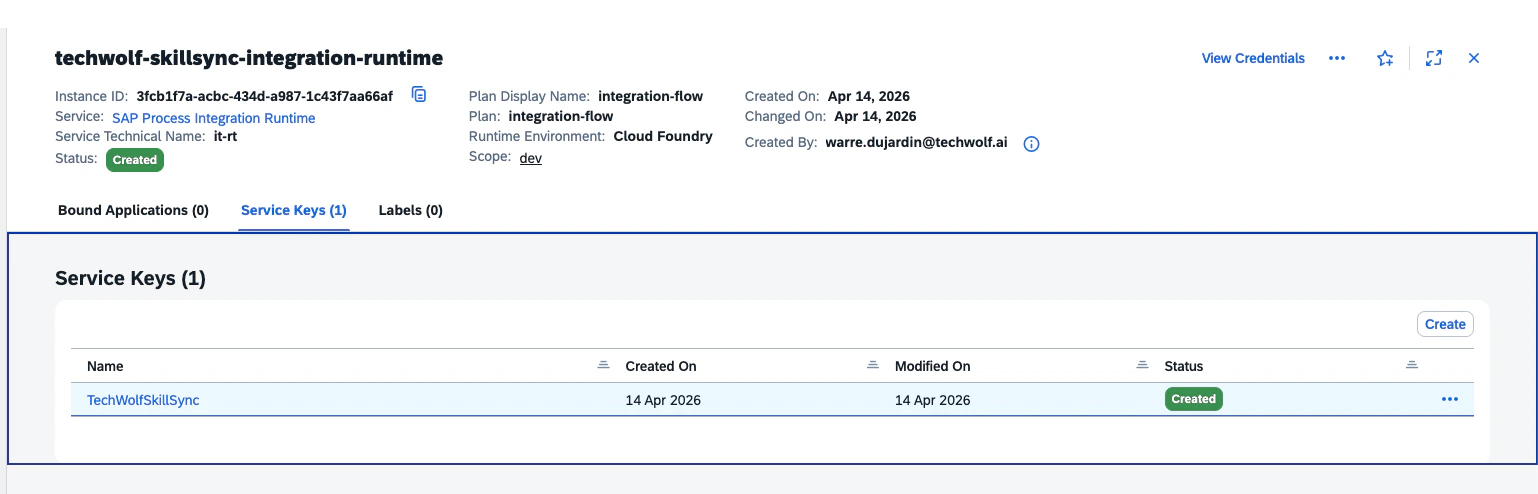
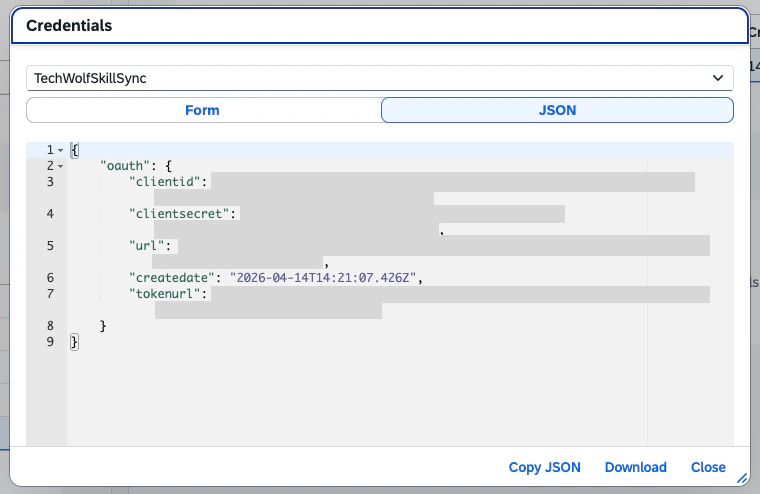
9. Import the Content Package
In SAP Integration Suite, go to Design > Integrations and APIs and click Import.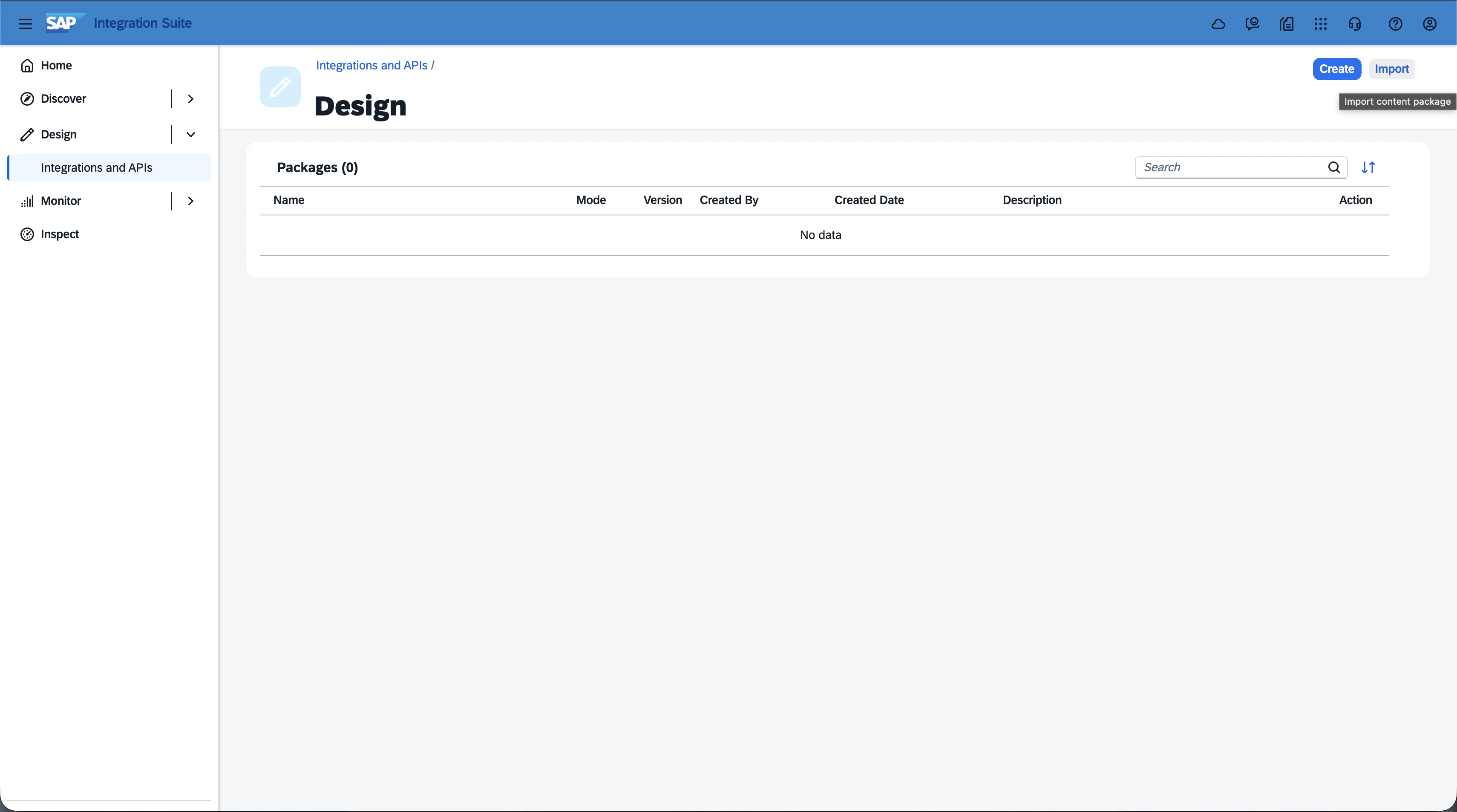
10. Configure the externalized parameters on the iFlow
Open the imported package and go to Artifacts.
Finding the SuccessFactors datacenter URL: in the Address field,
click Select to see the list of valid SAP SuccessFactors data centers
and pick the one matching your tenant (e.g.
https://apisalesdemo2.successfactors.eu). See
How To: Find the SAP SuccessFactors Company ID and API URL
for how to look up this URL.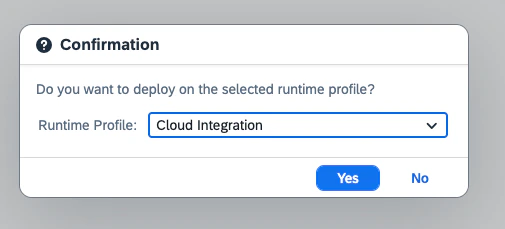
Update Employee Growth Portfolio in SAP SuccessFactors
- Tab Sender: set User Role to the role created in Step 6 (e.g.
TechWolfSkillSync.send).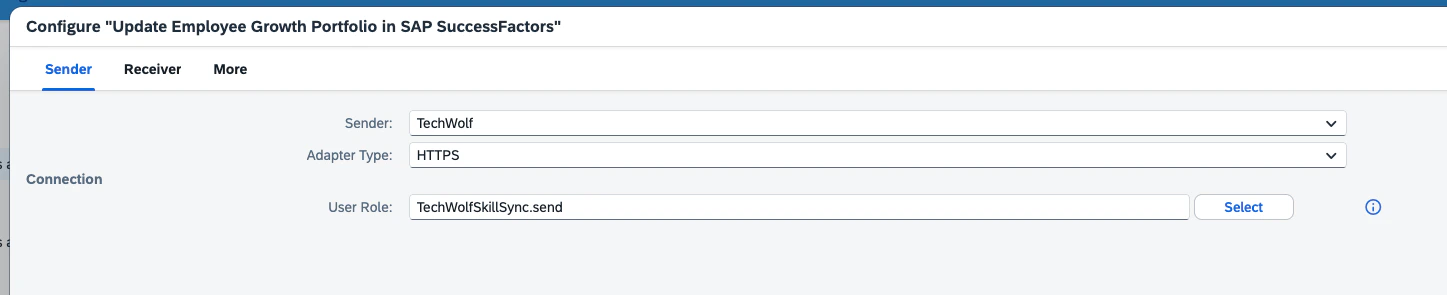
- Tab Receiver: set Credential Name to the OAuth 2 SAML Bearer Assertion
created in Step 5.
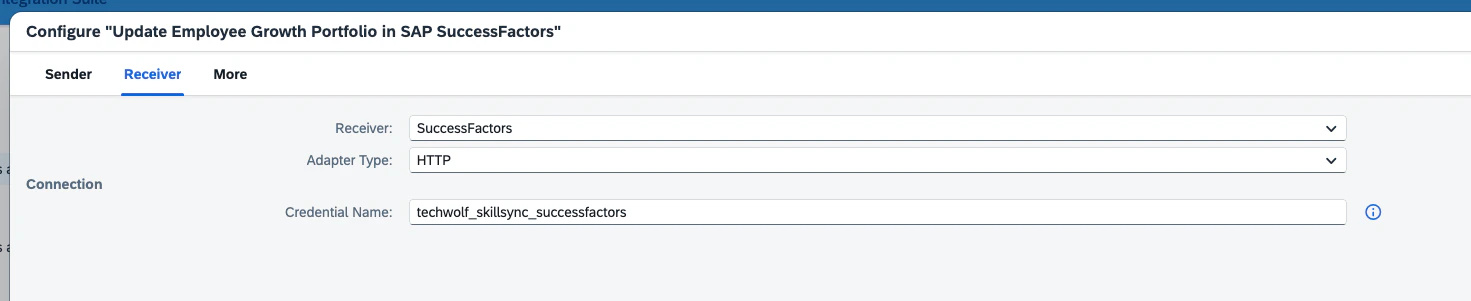
- Tab More: set Address to the URL of your SuccessFactors datacenter,
and AIR_key to the AIR key provided by your TechWolf representative.

11. Create Employee Growth Portfolio Export Schedule
Integration Center schedules run under the account of the user that creates them. Ensure this user has all permissions listed below before setting up the schedules.We recommend setting up the schedules with a dedicated technical user
rather than a named administrator account. Schedules created by a named
account break when that account is deactivated. An administrator creates
the technical user, grants it the permissions below, and proxies as it
while creating the schedules. Setting up the schedules directly as an
administrator with these permissions also works.
-
Under
User Permissions→Talent Intelligence Hub: -
Under
Administrator Permissions:
Start Time of the schedule is set to be
some time (e.g. one hour) after the time of day of the Start Time of the
Attribute Import Schedule (Step 1) of the
Skills Taxonomy Sync .
Base ICD:
Talent Intelligence Hub Growth Portfolio Export
The ICDs provided by TechWolf are based on the default integration definitions by SAP, as indicated by the Base ICD mentioned.
These have been pre-filled with some necessary values such as the file name prefix for your convenience, to ease the setup process.
TechWolf is committed to keeping these integration definitions up to date with the latest SAP SuccessFactors releases, but cannot guarantee full alignment with the SAP SuccessFactors release schedule.
Should issues arise when using these integration definitions, please contact support@techwolf.ai.
Verify the deployment
- In SAP Integration Suite, go to Monitor > Integrations and APIs > Manage Integration Content and confirm that all deployed iFlows show the Started status.
- Go to Monitor > Integrations and APIs > Monitor Message Processing to watch messages as TechWolf triggers the iFlows. Failed messages include the HTTP response from SuccessFactors, which is the fastest way to diagnose authentication or permission issues (e.g. expired certificate, missing SuccessFactors permission, incorrect AIR key).
TechWolf Configuration
The TechWolf tenant will be configured by TechWolf itself. To complete the setup, share the following values with your TechWolf representative:- The downloaded service key file from Step 8 (via 1Password or another agreed secure channel).
Routing Through an API Gateway
If your organisation fronts the SAP BTP APIs with an API gateway, the integration can call the gateway instead of the vendor host directly. Two settings are available, both configured by TechWolf together with the credentials:- Custom URL: instead of the vendor API URL, share the gateway URL that proxies it. The integration keeps appending the same vendor API paths to it, so the gateway must forward requests to SAP BTP unchanged.
- Custom headers: any number of extra HTTP headers (for example an API key or a correlation ID required by the gateway) that are sent on every request the integration makes.
Both settings are pass-through only. TechWolf sends the values as configured
and does not perform any gateway-specific authentication, signing, or token
refresh; the gateway is expected to forward the integration’s own
credentials to SAP BTP. Reserved headers (e.g.
Authorization,
Content-Type) are managed by the integration and cannot be set as custom
headers.Configuration Options
Sync Direction Settings
The integration supports three sync direction options:- Bidirectional (default): Two-way sync between TechWolf and SAP SuccessFactors; changes made in TechWolf Employee Skill Profiles are synchronized to their corresponding SAP SuccessFactors Growth Portfolios, and vice versa.
- TechWolf to SAP Only: Skills flow from TechWolf to SAP SuccessFactors only; changes made in TechWolf Employee Skill Profiles are copied to their corresponding SAP SuccessFactors Growth Portfolios, while changes made in SAP SuccessFactors are discarded and overwritten with the state of the TechWolf Employee Skill Profiles.
- SAP to TechWolf Only: Skills flow from SAP SuccessFactors to TechWolf only; changes made in SAP SuccessFactors Growth Portfolios are copied to their corresponding TechWolf Employee Skill Profiles, while changes made in TechWolf are discarded and overwritten with the state of the SAP SuccessFactors Growth Portfolios.
Merge Strategy Options
For the correct functioning of the normal operation of the integration, the Employee Skill Profiles in both systems should be initially aligned. The integration will do this initial alignment itself automatically when the integration is first enabled, or when it is re-enabled after having been paused, or when it encounters an Employee it had no knowledge about yet. The initial alignment can happen in different ways; the integration supports three such merge strategy options:- Merge Systems: Combines Skills from both systems. In case of metadata conflicts for Skills present in both systems (e.g. conflicting proficiency levels), the values from TechWolf will be used.
- Push TechWolf: Uses the TechWolf Employee Skill Profile as the initial source of truth, and will align the SAP SuccessFactors Growth Portfolio with it. Any Skills initially present in the SAP SuccessFactors Growth Portfolio but not in the TechWolf Employee Skill Profile will be removed from the SAP SuccessFactors Growth Portfolio.
- Push SAP: Uses the SAP SuccessFactors Growth Portfolio as the initial source of truth, and will align the TechWolf Employee Skill Profile with it. Any Skills initially present in the TechWolf Employee Skill Profile but not in the SAP SuccessFactors Growth Portfolio will be removed from the TechWolf Employee Skill Profile.
Deployment Tasks & Responsibilities
- TechWolf: Setup Skill Sync environment and tenant requirements.
- Customer: Configure SAP BTP and SAP SuccessFactors as described above.
- Customer: Share the necessary values with TechWolf:
- The service key file from Step 8.
- TechWolf: Validate API access by calling the iFlow end-to-end.
- TechWolf: Enable the schedule to consume the SAP SuccessFactors Growth Portfolio export files from the SFTP server.
- TechWolf: Run the initial sync of Employee Skill Profiles with the TechWolf API.
- TechWolf: Setup tenant configuration and start the sync process based on the configured direction.
- Customer: Check end-user test scenarios.