> ## Documentation Index
> Fetch the complete documentation index at: https://developers.techwolf.ai/llms.txt
> Use this file to discover all available pages before exploring further.
# Skill Events
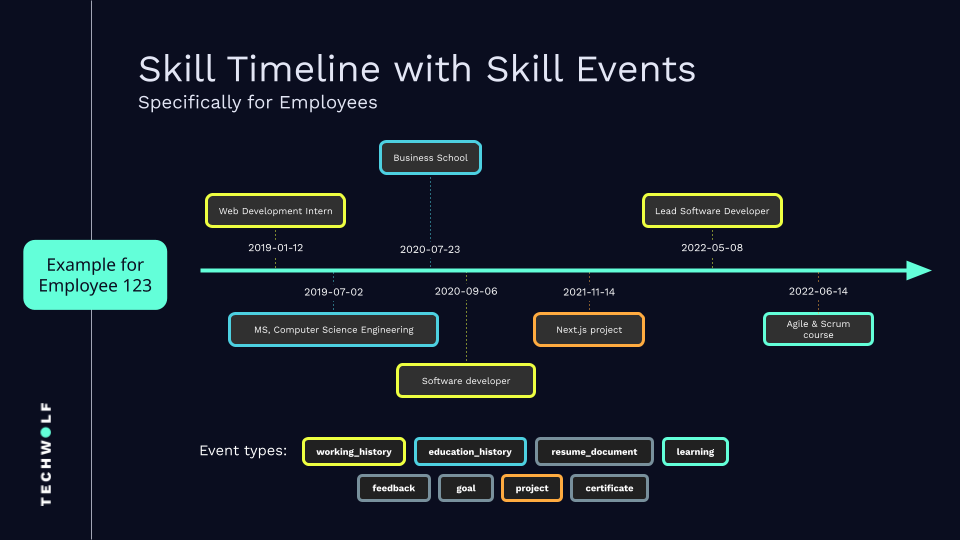
The skill set of an employee is not static. Over time, a person will work on
many projects and topics, follow courses, and change positions. Past experiences
become irrelevant compared to newer ones. The concept of Skill Events allows
adding those.
 Skill Events can be added via a `POST` call to the
`/employees/{employee_external_id}/skill_events`
endpoint.
There are currently 11 event types supported, which all have different `content`
in the request body. For example, take Employee 101 with the following history:
* Graduated “Computer Science” in 2018
* Worked as a “Software Developer” from 2018-2020 & afterwards started a job as
“Product Owner”
* Took a course on “Agile & Scrum” in 2021
Adding these events to the Employee can by calling
`/employees/101/skill_events?language=auto` with the following bodies:
```JSON theme={null}
{
"external_id": "degree-101-1",
"event_type": "education_history",
"timestamp": "2018-07-01",
"source": "oracle",
"content": {
"degree_name": "Computer Science"
}
}
```
```JSON theme={null}
{
"external_id": "working-history-101-1",
"event_type": "working_history",
"timestamp": "2020-05-02",
"source": "oracle",
"content":
{
"start_date": "2018-09-01",
"end_date": "2020-05-02",
"job_title": "Software Developer",
"job_description": "Tools: Scala, Git, Docker"
}
}
```
```JSON theme={null}
{
"external_id": "working-history-101-2",
"event_type": "working_history",
"timestamp": "2020-05-02",
"source": "oracle",
"content": {
"start_date": "2020-05-02",
"job_title": "Product Owner",
"job_description": "-"
}
}
```
```JSON theme={null}
{
"external_id":"learning-101-1",
"event_type": "learning",
"timestamp": "2021-05-01",
"source": "coursera",
"content": {
"learning_title": "Agile & Scrum",
"learning_description": "In this course you learn the fundamentals of Agile:stand-ups, retrospectives, sprints, …"
}
}
```
When adding a Skill Event, it automatically contributes to the Skill Profile -
which is why you should only send completed events. (i.e. when a certificate is
obtained or a goal is accomplished). Requesting the Skill Cluster profile of this
Employee can via a `GET` call to the
`/employees/101/skill_profile?response_format=skill_clusters`
endpoint.
The response body will be as follows:
```JSON theme={null}
{
"external_id": "a3903505-eb84-42dc-a79f-5e7b1fe897b7",
"num_skill_events": 5,
"skill_clusters": [{
"skill_cluster_name": "Programming",
"proficiency_level": 2
}, {
"skill_cluster_name": "Business Intelligence",
"proficiency_level": 3
}]
}
```
Skill Events can be added via a `POST` call to the
`/employees/{employee_external_id}/skill_events`
endpoint.
There are currently 11 event types supported, which all have different `content`
in the request body. For example, take Employee 101 with the following history:
* Graduated “Computer Science” in 2018
* Worked as a “Software Developer” from 2018-2020 & afterwards started a job as
“Product Owner”
* Took a course on “Agile & Scrum” in 2021
Adding these events to the Employee can by calling
`/employees/101/skill_events?language=auto` with the following bodies:
```JSON theme={null}
{
"external_id": "degree-101-1",
"event_type": "education_history",
"timestamp": "2018-07-01",
"source": "oracle",
"content": {
"degree_name": "Computer Science"
}
}
```
```JSON theme={null}
{
"external_id": "working-history-101-1",
"event_type": "working_history",
"timestamp": "2020-05-02",
"source": "oracle",
"content":
{
"start_date": "2018-09-01",
"end_date": "2020-05-02",
"job_title": "Software Developer",
"job_description": "Tools: Scala, Git, Docker"
}
}
```
```JSON theme={null}
{
"external_id": "working-history-101-2",
"event_type": "working_history",
"timestamp": "2020-05-02",
"source": "oracle",
"content": {
"start_date": "2020-05-02",
"job_title": "Product Owner",
"job_description": "-"
}
}
```
```JSON theme={null}
{
"external_id":"learning-101-1",
"event_type": "learning",
"timestamp": "2021-05-01",
"source": "coursera",
"content": {
"learning_title": "Agile & Scrum",
"learning_description": "In this course you learn the fundamentals of Agile:stand-ups, retrospectives, sprints, …"
}
}
```
When adding a Skill Event, it automatically contributes to the Skill Profile -
which is why you should only send completed events. (i.e. when a certificate is
obtained or a goal is accomplished). Requesting the Skill Cluster profile of this
Employee can via a `GET` call to the
`/employees/101/skill_profile?response_format=skill_clusters`
endpoint.
The response body will be as follows:
```JSON theme={null}
{
"external_id": "a3903505-eb84-42dc-a79f-5e7b1fe897b7",
"num_skill_events": 5,
"skill_clusters": [{
"skill_cluster_name": "Programming",
"proficiency_level": 2
}, {
"skill_cluster_name": "Business Intelligence",
"proficiency_level": 3
}]
}
```